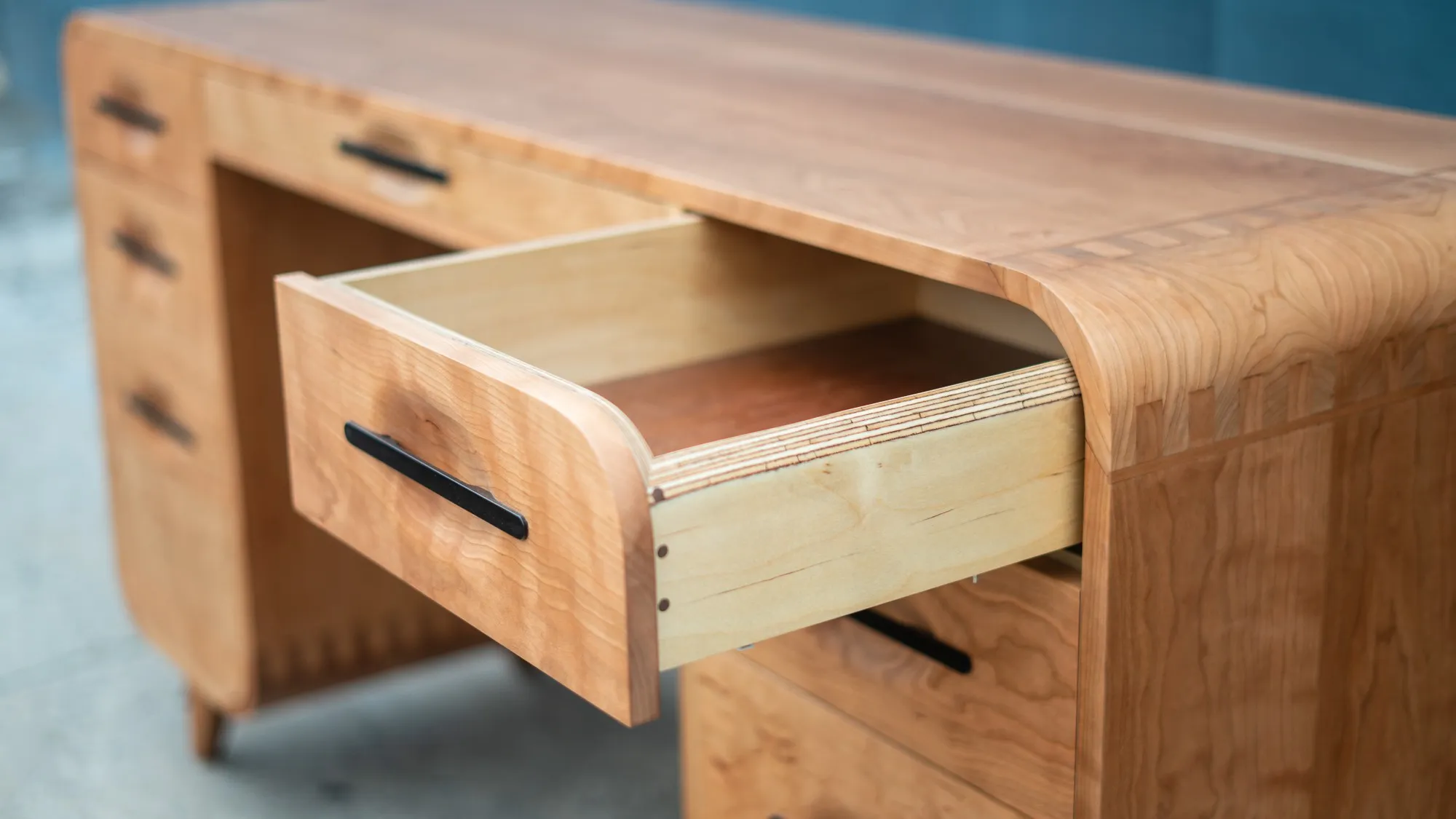
Cherry Executive Desk
A mid-century executive desk in solid cherry, with a rolled top, finger-jointed corners and drawer pulls set into the fronts.
Solid cherry · Ebony pulls · Leather drawer linings
Dining tables
Dining and conference tables built by hand in San Diego, in solid hardwood, with the top and base designed together so the piece stays flat and rigid for decades.
What to think about
A dining table is the piece of furniture a household uses most and replaces least. It is also the one where a standard size is least likely to suit, because the constraint is not the table, it is the walk-around space in the room it has to live in.
Two measurements set almost everything. Each person needs roughly 24 inches of table edge to eat without knocking elbows, and every chair needs about 36 inches behind it to be pulled out and sat in. Subtract the second from the room and the first tells you how many people you can genuinely seat, which is often one or two fewer than people hope.
Shape follows from there. A round table seats more people in less floor area and makes conversation easier, but stops working much beyond 60 inches across because the middle becomes unreachable. A rectangular table suits a long room and extends more gracefully. Long tables need their base worked out carefully so nobody ends up sitting on a leg.
A solid wood top is not a static object. It takes on moisture in humid weather and gives it back in dry weather, and nearly all of that movement happens across the width of the boards rather than along their length. A 40 inch top can change measurably between February and August.
A table that lasts is built to allow for that: the top is fastened to the base in a way that holds it flat while still letting it expand and contract. Tops that crack are almost always tops that were fixed rigidly to a frame that would not move with them. This is the single biggest difference between a table built by someone who understands wood and one that was assembled.
Four legs and an apron is the traditional answer and the most rigid. A trestle or pedestal frees up the legroom and moves the engineering into the centre. A half-lapped or interlocking base, where the members are notched into each other rather than simply butted, resists racking because it puts long grain against long grain across a wide glue face. The choice is partly aesthetic and entirely structural.
The same thinking scales up for offices, with two additions: power and data have to be routed through the top or the base, and the whole thing usually has to come apart to get into the building. Both are design decisions, not afterthoughts, so bring the floor plan and the lift dimensions to the first conversation.
Recent work
A mid-century executive desk in solid cherry, with a rolled top, finger-jointed corners and drawer pulls set into the fronts.
Solid cherry · Ebony pulls · Leather drawer linings
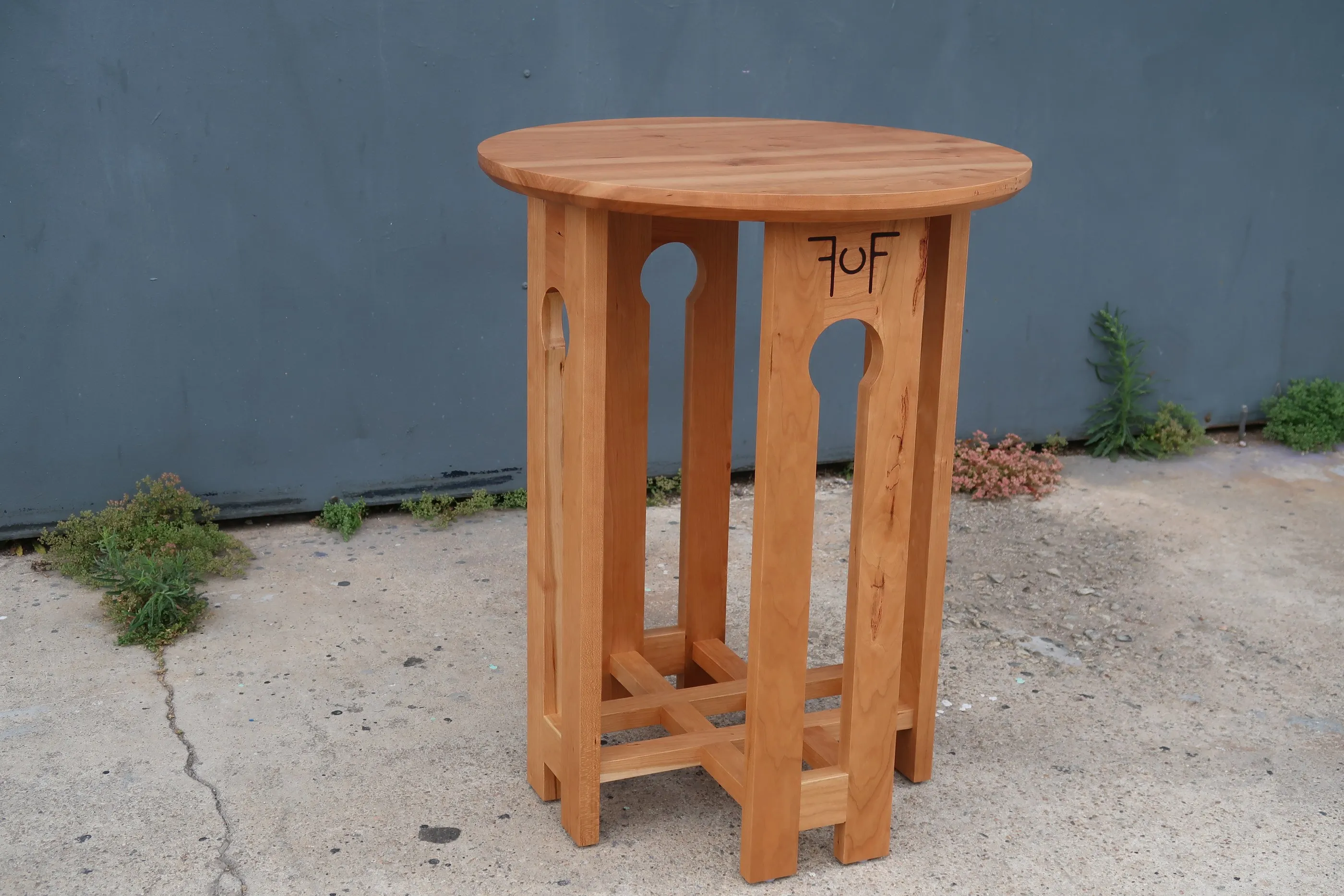
A modern reading of a craftsman side table in cherry, with keyway cutouts through the legs and a crosshatch half-lap base.
Cherry
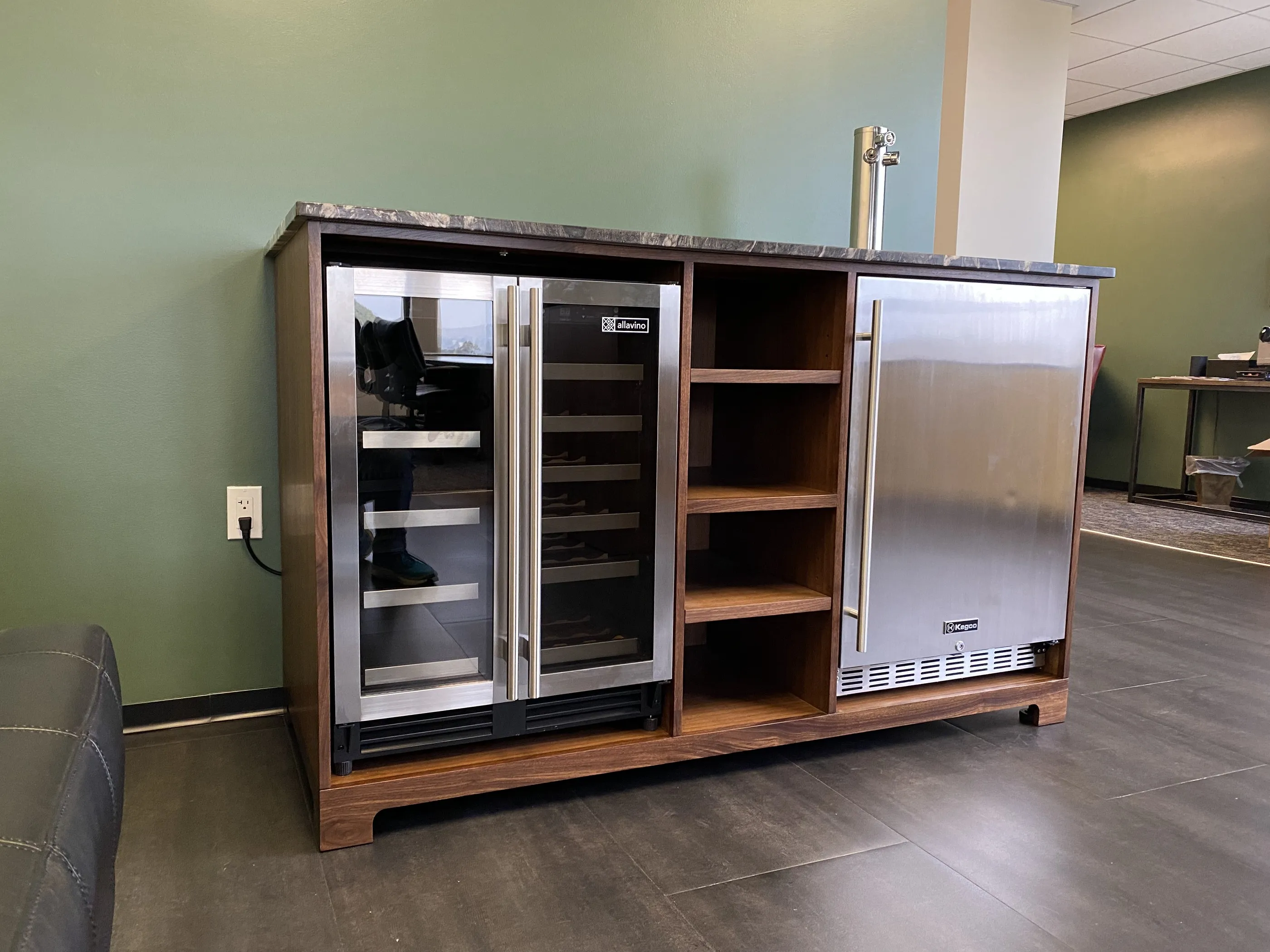
A walnut bar cabinet built to a client's specification around their own appliances, with a stone top and open central shelving.
Walnut · Sustainable veneer · Plywood and hardwoods
Common questions
Tell Bryan what you need and where it is going. Photographs of the space, a sketch on the back of an envelope, or a picture of something you saw once — all of it helps.
Or reach Bryan directly:
(760) 855-7701 bryan@ferriscustomfurniture.com